
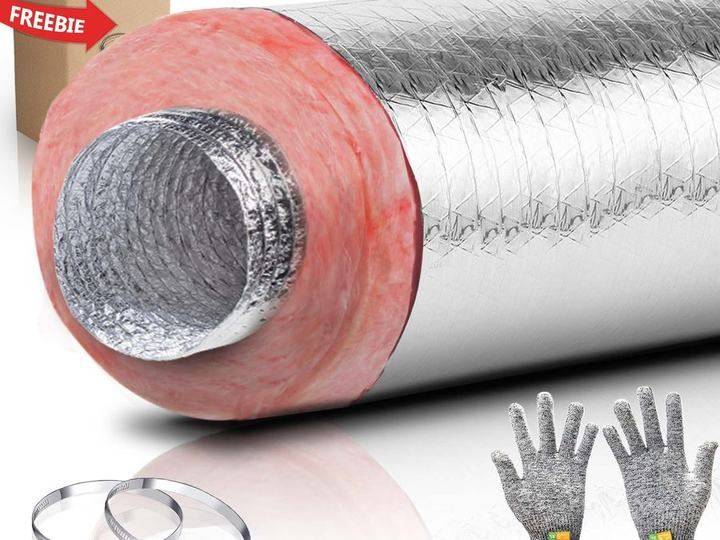
Insulated Duct R8.0
50 mm insulation. For demanding work — exposed rooftops, cold chain, plant rooms. Not every project needs it, but where it is needed R6 will not hold up.
Four layers, what each one does
From inside out:Inner corea foil-polyester laminate that seals the bore, keeps it smooth and resists dust;Insulationthe glass wool — all the thermal resistance comes from this layer; Wire helixholds the shape, resists negative pressure and sets the bend radius;Jacketfoil plus polyester, blocking UV, water and site knocks.
The jacket is the layer most often cut. Cheap duct thins the fourth layer so you cannot tell during installation; a year later it cracks from the joints, moisture follows the cracks into the wool, and by then the insulation has failed while the outside still looks fine.
Where it fits
Three installation points
Tape every seam once, then wrap the whole run once more. Do not skip this step.
Fill the opening before sealing it and leave no air pocket — that is a channel for moisture.
A metal hanger clamped straight onto the duct forms a thermal bridge — fit a rubber or insulation pad.
FAQ
Is R8 too thick to fit?
About 24 mm more in outer diameter than R6. When ceiling space is tight, reroute the run rather than drop a grade.
How much more does R8 cost than R6?
Priced by insulation material volume, roughly 25–35% higher at the same diameter. Quoted by order quantity.
How many years outdoors?
The jacket is a foil-polyester laminate, UV resistant under normal installation; but poor joint work is where its service life starts to fail.
More technical questions:Technical Q&A (19 answers)