
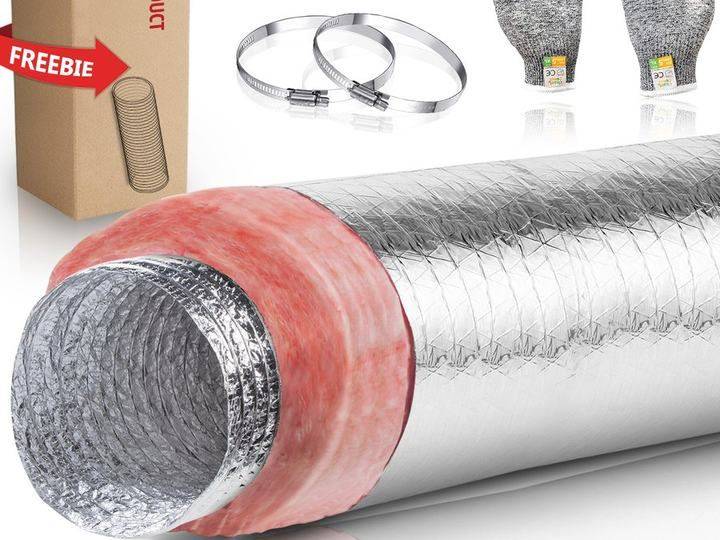
Insulated Duct R6.0
38 mm insulation. Once the run gets long or the temperature difference grows, R4.2 stops being enough — use R6 on mains and long runs and terminal air temperature keeps up with the unit setpoint.
Four layers, what each one does
From inside out:Inner corea foil-polyester laminate that seals the bore, keeps it smooth and resists dust;Insulationthe glass wool — all the thermal resistance comes from this layer; Wire helixholds the shape, resists negative pressure and sets the bend radius;Jacketfoil plus polyester, blocking UV, water and site knocks.
The jacket is the layer most often cut. Cheap duct thins the fourth layer so you cannot tell during installation; a year later it cracks from the joints, moisture follows the cracks into the wool, and by then the insulation has failed while the outside still looks fine.
Where it fits
Three installation points
One hanger every 1.5 m on long runs, plus one on each side of a bend.
Make wall openings at least 20 mm larger than the duct so the jacket is not rubbed through.
At beams, lower the ceiling rather than flatten the duct — a flattened section loses its insulation value.
FAQ
When should I move up from R4.2 to R6?
Three signals: a branch over 10 m, a run through unconditioned space, or a strict terminal temperature. Any one of them means step up a grade.
How much thicker is R6 than R4.2?
About 26 mm more in outer diameter. Allow for it in the ceiling void up front, especially with ducts side by side.
Can the length be customized?
Yes, customized per market (model suffix -C), commonly cut to container-loading ratios.
More technical questions:Technical Q&A (19 answers)