
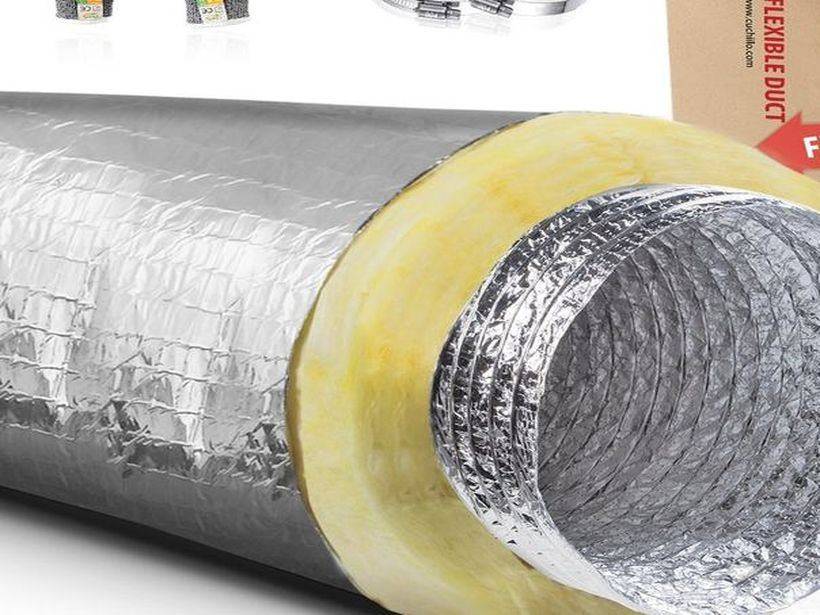
Insulated Duct R4.2
25 mm insulation, the default for standard AC branches. No condensation, sensible cost — enough for supply branches in guest rooms, offices and shops.
Four layers, what each one does
From inside out:Inner corea foil-polyester laminate that seals the bore, keeps it smooth and resists dust;Insulationthe glass wool — all the thermal resistance comes from this layer; Wire helixholds the shape, resists negative pressure and sets the bend radius;Jacketfoil plus polyester, blocking UV, water and site knocks.
The jacket is the layer most often cut. Cheap duct thins the fourth layer so you cannot tell during installation; a year later it cracks from the joints, moisture follows the cracks into the wool, and by then the insulation has failed while the outside still looks fine.
Where it fits
Three installation points
Bend tighter than 1.5 times the outer diameter and the jacket creases — the creases are the first place to condense.
Press one full ring of foil tape along the seam — not a couple of casual wraps.
Space hangers too far apart and the duct sags under its own weight, compressing the wool — that section loses much of its insulation value.
FAQ
What is the difference between R4.2 and R6?
Mainly the insulation thickness: 25 mm versus 38 mm. Use R4.2 for branches under 10 m at standard temperature difference; step up to R6 for mains or runs through unconditioned spaces.
Can it be used as an exhaust duct?
Fine for short exhaust runs that need no insulation, but for sustained negative pressure choose a dense helix so the duct is not sucked flat.
Minimum order quantity?
Trial from one roll, LCL available. Mixed diameters can share a container.
More technical questions:Technical Q&A (19 answers)